Showing posts with label What_Works. Show all posts

Monday, January 03, 2011

What Works: Furs and Ice by Josh R. Vogt

Today's excerpt for the "What Works" blog series is not an excerpt at all, but an entire story--specifically a piece of flash fiction written by blog-buddy Josh R. Vogt for the Clarity of Night competition.

Furs and Ice
By Josh R. Vogt

All futures hide in the clouds, Father told him. Trap the sky beneath your feet, and walk what must come.

As Omen trudges onto the frozen lake, he scratches at the wolf pelts cloaking him. Oracles always wear stinking furs.

Such is our way, Father said.

Omen hates stinking furs. He smells the rancid unguent Father drank each morning, trying to ward off the bleeding cough. Its stench tainted the old oracle's breath, his bowels, the hide walls of their hut. Now it follows like Father's ghost, come to see the son's first foretelling.

He reaches the middle of the lake and stands amidst the gray reflections of cloud and twig and crag. Omen stomps. Ice shrieks. Its polish shatters into a maze of cracks. The reflections within no longer move, trapped for his scrutiny. Trapped, just as he is. Forever an oracle, wearing the stinking furs of a babbler.

Omen's feet are numbing. Skin sticks to the ice as he steps towards shore. He hunches, looking for signs to convey.

There, branches knot in a telling of early summer. Beside this, a rounded cliff predicts many births within the tribe. A step further--

Omen stops. Stares at the next frozen vision. A bird's spread wings reveal a chance for freedom, offered to those with the strength to grasp it.

The future within the ice groans for release.

He raises his foot for another stomp. It will be a bitter swim to shore, but faster once he sheds the furs.
I love this piece as an example of what to aim for in your writing because it's so short, and yet it demonstrates so perfectly how to structure a story.

As I've mentioned before, stories are about change. They start when the protagonist's life is knocked out of balance and they end when that life is brought back into a new, different form of balance.

Also, every scene in a story should revolve around a turning point--a moment of irrevocable change, one where the characters involved cannot step back from or undo what has happened. In a flash fiction piece, you only have time for a single turning point. In fact, the turning point is the entirety of the story; everything else in the work is there to support the turning point.

The first sentence of Furs and Ice begins to establish the world that the protagonist, Omen, lives in; foretelling is a real profession, and the protagonist's father taught Omen to give himself over to his fate.

The second sentence immediately establishes a tension between this lesson and the protagonist's own beliefs. Omen trudges, which implies a lack of enthusiasm, and he thinks the furs he has to wear smell terrible. This is not a portrait of person who is happy to accept his fate.

The third sentence underscores the internal tension by fleshing out what Omen's father taught his son, while the next paragraph firmly establishes Omen's distaste for the role he is supposed to step into. The line "... [the stench] follows like Father's ghost, come to see the son's first foretelling" makes it clear Omen feels trapped by tradition and familial obligation.

In just a few sentences, the author has set up a strong and relatable tension between what Omen wants and what his father wanted for him. This tension whets our curiosity; Omen's life is out of balance, and we know something is going to break. We keep reading to find out what.

The next three paragraphs show Omen seemingly acquiescing to his fate; he does the job he's supposed to do. He reads the fortunes of the tribe, and although his internal situation is unstable, externally, he gives the impression of accepting the status quo.

But then, the foretelling shows Omen a way out, and he doesn't even hesitate. The story ends right at its lone turning point--Omen's moment of irrevocable change. He chooses to stomp on and break the ice, abandon his tribe and his fate, fling off the hated furs, and swim to a new life.

A story, to feel complete, needs to take an unbalanced situation and restore it to balance, but in such a way that the protagonist's final state is different than his initial state.

At the end of this story, Omen has restored his internal balance and is mentally in a new place. His external life is very much in chaos, but given the author highlighted the internal conflict, not any external ones, this feels like a satisfying resolution to the story.

Now let's look at the work in another way.

A story's turning points are often called reversals. The protagonist's life is either in a good or a bad state, and the turning point changes it to the opposite status.

Right before the final, largest reversal, it's common for the storyteller to try to make the audience think this is the protagonist's final state. It's often called the "black moment" because this is usually a state worthy of despair--one seemingly without hope.

And, usually, the hero makes one last, valiant effort immediately after the black moment and saves the day after all.

In Furs and Ice, when Omen is foretelling for his tribe, this is effectively his black moment. He has apparently chosen to accept his fate even though that fate makes him very unhappy. But then the reversal occurs: Omen makes one last, valiant effort and gets what he wants after all.

In Summary:

What works about this piece is that it is about change, as all stories must be. Omen wants a different life and finds a way to get it. Despite the story being very short, it nevertheless bases itself around a compelling and satisfying turning point in the protagonist's life.

The work also establishes tension, a promise that in this situation things must change, which is what keeps readers engaged in the story.

This piece has a satisfying ending because it gives the protagonist what he needed, albeit at a price. The author builds up tension, then releases it via a solution to the protagonist's problem, and this release is what creates a feeling of satisfaction in the reader.


Of Interest:

Josh is a newly-agented writer with a book out on submission to publishers--wish him luck! He also just launched a new blog called Write Strong, which features technical discussions on the subject of becoming a better writer. I encourage you all to check it out!


Author website: J. J. DeBenedictis

Sunday, December 05, 2010

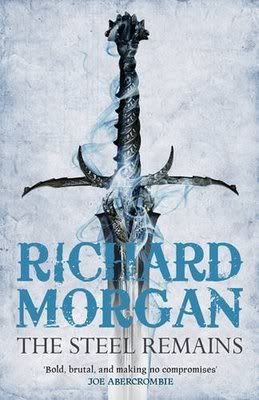
What Works: The Steel Remains by Richard Morgan

This edition of What Works focuses on one of the most rip-snorting, unrestrained and wonderful fantasy novels I've read, The Steel Remains by Richard Morgan.

This book doesn't hold anything back, and for that reason I'd only recommend it to people who know they can handle foul language, graphic violence and graphic sex. That said, hoo boy do I recommend it! The novel is brilliant and shocking, with wonderful characters, great writing, and a hugely imaginative, quasi-science fiction take on the idea of elves.

Ahem. Enough fan-girling. Here's an excerpt, and please note there is some very rude language here.
The Steel Remains by Richard Morgan

And from within the closed iron cylinder, more precisely from the mouth of one downthrown open hatch in a row of five that were set into the underside of the hull, came the furious, repeated clang of metal pounding on metal. The sound, it seemed, of something trying to escape.

Glances went back and forth, hands dropped to the hilts of well-worn weapons. The Emperor's messengers drew closer at a pace that declined with every step they took into the shadow of the fireship's propped bulk. Finally, they piled to a halt just inside the circumference of the dry-dock framework that supported the vessel, and a good dozen paces back from the hatch, all of them careful not to step on any of the drooping feelers that trailed from the hull and lay flopped in the shipyard dust like so many discarded carriage whips. No telling when something like that, no matter the intervening years of disuse, might twist and snap to sudden murderous life, coil about an unwary limb and jerk its owner off his feet and screaming into the air, to be lashed back and forth or slammed to a pulp against the grimy iron flank of the ship.

"Syphilitic son of an uncleased, camel fucking CUNT!"

A massive metallic crash fringed the final word, but could not drown it out. The messengers flinched. In places, blades came a few inches clear of their sheaths. Hard on the echoes of the impact, before anyone could move, the voice started up again, no cleaner of expression, no less rabidly furious, no less punctuated by the clangour of whatever arcane conflict was raging in the confines of the hull. The messengers stood frozen, faces sweat-beaded from the fierce heat of a near-noon sun, while recollected witch rumours crept coldly up and down their bones.

"Is it an exorcism?"

"It's krinzanz," reckoned a more pragmatic member of the party. "She's off her fucking head."

Another of the messengers cleared his throat.

"Ah, Mistress Archeth..."

"...motherfucking close-mouth me, will you, you fucking..."

"Mistress Archeth!" The Reachman went up to a full-scale shout. "The Emperor wills your presence!"

The cursing stopped abruptly. The metallic cacophony died. For a long moment, the open hatch yawned and oozed a silence no less unnerving than the noise that had gone before. Then, Archeth's voice emerged, a little hoarse.

"Who's that?"

"From the palace. The Emperor summons you."

Indistinct muttering. A clank, as the engineer's hammer was apparently dropped, and then an impatient scrambling sound. Moments later, Archeth's ebony head emerged upside down from the hatch, thickly braided hair in stiff disarray around her features. She grinned down at the messengers, a little too widely.

"All right," she said. "I've done enough reading for one day."
There are a bunch of things that work really well in this excerpt, so I'll outline the ones that stick out to me.

001) The group of messengers are treated as a composite entity, not individuals. Their emotions and actions are described homogeneously.

This is useful because one of the things novels don't do well is deal with complex scenes featuring lots of characters. When there are too many elements in a scene, the reader can't keep the positions, names and conversations straight in their head.

If you must portray a scene with many people in it, either you need to focus in on one small piece of the scene at a time, or work very hard to keep the reader clear on what is going on, or you need to do what Mr. Morgan does and simplify things.

Describing a group of people as if they're a single entity accomplishes this. None of the messengers are given names and they're either described as a homogeneous group or treated as interchangeable. Anything else would be confusing to the reader.

010) Almost every action and emotion is shown, not told.

The messengers bunch together and slow their pace; they touch their weapons; they sweat. Fantasies about murderous ship-tentacles and witch powers pass through their (collective) mind.

But the author doesn't say these men are frightened. That's implied.

Likewise, Archeth's rage, and then her silence and subsequent movement to the fireship's hatch, are only described. The author keeps us firmly inside the head of the group entity that is the messengers. The scene's action is something the reader has to work out from pure description.

The reader can also work out that Archeth is black (in a book that has thus far only featured white characters) without the author needing to say so explicitly. Archeth will prove to be a starkly unique person in The Steel Remains--literally half-alien--and this is a natural way to introduce one of her most obvious differences.

011) The character of Archeth is set up in a memorable way, and in a way that will likely make at least some readers empathize with and like her.

She's an engineer, but when we meet her, she's beating a machine with a hammer and swearing viciously at it. This is a moment most of us can empathize with.

When she then gets surprised by the Emperor's representatives, she is probably embarrassed, but she recovers quickly, offers zero apologies and even makes a joke of it. In other words, she's a confident and bold person, although possibly a little gonzo. This makes her quite likable.

In Summary: What works best about this excerpt is the author makes some very smart choices and shows a firm grasp of his craft. He simplifies the thing that would be most confusing (the individual identities of the group of messengers), skillfully shows (rather than tells) the reader what the characters are doing and feeling, and establishes his major character in an engaging and memorable manner.


Author website: J. J. DeBenedictis

Monday, August 09, 2010

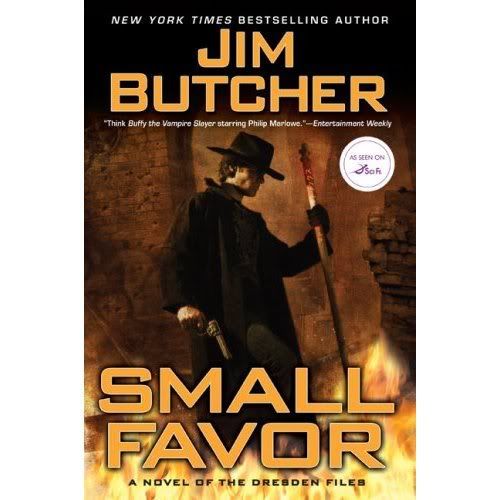
What Works: Small Favor by Jim Butcher

This week I return to my "What Works" blog feature where I discuss what's done well in an excerpt from a book. Today we'll look at a passage from Jim Butcher's Small Favor.


First a bit of set-up: in this scene, the protagonist Harry Dresden is trying to escape from an enormous creature called a gruff. A gruff is a huge, sentient, occasionally-magic-wielding billy goat--as in the three billy goats Gruff.

And hence you know the Harry Dresden series features a lot of humour.
Small Favor by Jim Butcher

Anybody with an ounce of sense knows that fighting someone with a significant advantage in size, weight, and reach is difficult. If your opponent has you by fifty pounds, winning a fight against him is a dubious proposition, at best.

If your opponent has you by eight thousand and fifty pounds, you've left the realm of combat and enrolled yourself in Roadkill 101. Or possibly in a Tom and Jerry cartoon.

(snip)

My body, meanwhile, had flung itself to one side forcing Tiny to turn as he pursued me, limiting his speed and buying me a precious second or three--time enough for me to sprint toward a section of floor marked off by a pair of yellow caution signs, where Joe the janitor had been waxing the floor. I crossed the wet, slick floor at a sprint and prayed that I wouldn't trip. If I went down it would take only one stomp of one of those enormous hooves to slice me in half.

Footgear like that isn't so hot for slippery terrain, though. As soon as I crossed to the other side of the waxed floor I juked left as sharply as I could, changing direction. Tiny tried to compensate and his legs went out from under him.

That isn't a big deal, by itself. Sometimes when you run something happens and you trip and you fall down. You get a skinned knee or two, maybe scuff up your hands, and very rarely you'll do something worse, like sprain your ankle.

But that's at human mass. Increase the mass to Tiny's size, and a fall becomes another animal entirely, especially if there's a lot of velocity involved. That's one reason why elephants don't ever actually run--they aren't capable of it, of lifting their weight from the ground in a full running stride. If they fell at their size, the damage would be extreme, and evidently nature had selected out all those elephant wind sprinters. That much weight moving at that much speed carries a tremendous amount of energy--enough to easily snap bones, to drive objects into flesh, to scrape the ground hard enough to strip a body to the bone.

Tiny must have weighed twice what an elephant does. Five tons of flesh and bone came down all along one side of his body and landed hard--then slid, carrying so much momentum that Tiny more resembled a freight train than any kind of living being. He slid across the floor and slammed into the wall of a rental car kiosk, shattering it to splinters--and went right on through it, hardly even slowing down.

Tiny dug at the floor with the yellow nails of one huge hand, but they didn't do anything but peel up curls of wax as he went sliding past me.
In this excerpt, Jim Butcher demonstrates how to handle explaining something that is not necessarily intuitive or believable to your reader.

My field of study was physics, so E=½mv² makes perfect sense to me. However, this is a book where magic is real--and where the author doesn't want to count on the reader remembering their high school physics.

If Mr. Butcher had merely shown Tiny being vanquished by falling down, it would have seemed a bit too convenient and thus unbelievable. After all, people and animals fall down all the time, and as Mr. Butcher points out, in our experience that's not a big deal. Furthermore, this book is set in a world where magic exists. Why would a magical creature necessarily be damaged by stumbling?

And so, Mr. Butcher eases you through a dubious plot point that would normally threaten your suspension of disbelief. He starts by acknowledging what your logical reservations to this moment would be--you've fallen down, and you know it's not so bad. Then he explains those reservations away--yeah, it's not bad for you, but for a larger animal, it could be devastating.

Then he gives you a vivid idea of what would happen to a large animal if it fell down while travelling at speed--broken bones, stripped flesh, impaled by foreign objects, oh my.

Then, and only then, he shows the gruff crashing down and sliding past the protagonist like a freight train, helpless to stop itself. And at that point, it's believable to you that this would happen.

If the tumble had occurred without all this explanation, your mind would have slipped out of the story for a moment while it puzzled over whether to actually believe this could happen. By convincing you before showing you, Mr. Butcher keeps your mind firmly planted inside the narrative.

Note Mr. Butcher hasn't actually explained away every reservation you might have. The gruff is a magical creature; why wouldn't it have natural defences against this sort of thing? If the world of the novel is already so divorced from our mundane reality that the gruff exists, why not divorce it a bit further so the gruff can exist? Without needing a LifeCall pendant?

The fact is, as long as your brain believes this event could happen, you'll keep ploughing through the exciting narrative without pausing long enough to realize it doesn't necessarily make sense even now. The author has convinced you this moment is plausible, and that is enough sleight-of-hand to keep your willing suspension of disbelief intact.

It's worth looking back at this excerpt and analyzing how it breaks down in terms of "show" versus "tell". There's a lot of "telling" in this passage, but all of it is necessary so Mr. Butcher can explain away your reservations. He does intersperse the "telling" with "showing" to keep you grounded in the story, but he also holds your interest with a few additional tricks.

Or possibly in a Tom and Jerry cartoon.

...evidently nature had selected out all those elephant wind sprinters.


Humour will keep people reading things that don't necessarily have a strong narrative, and the lines above are pretty funny. They act as a reward that keeps you reading through paragraphs that are otherwise striving to tell you something fairly boring about mass, velocity and energy.

Mr. Butcher also keeps his physics lesson vivid and visceral with plenty of real world examples you can picture in your head.

You get a skinned knee or two, maybe scuff up your hands...

That's one reason why elephants don't ever actually run--they aren't capable of it...


By doing these things, and by returning to the action via "showing" quite often, Mr. Butcher eases you through a problematic moment in the story--a point when you might have gone "hmm..." if he hadn't been using a variety of skills to keep you reading onward.

At a seminar I attended given by Donald Maass, he noted that writers of high-concept thrillers have to be able to do this on a larger scale. They can convince us that Jesus has been cloned, OMG, or some other insane thing--but they have to do it carefully in order to keep the reader's suspension of disbelief intact. He noted these authors start small, and convince us one tiny part of the whole picture is plausible. Then, they convince us that some other part of the mystery is also a possibility.

And so on, and so on, until they have built up the whole picture and have us, the reader, completely buying into a concept that would have made us laugh if we'd heard it cold, i.e. without all the careful build-up.

Mr. Butcher is doing exactly this--and skillfully too--but on a very small scale.

IN SUMMARY: What works about this excerpt is the author eases us through a moment when our suspension of disbelief might have been threatened. He does this by acknowledging our reservations and explaining them away, all the while keeping us engaged with the narrative via humour, vivid examples, and by returning to the action often during an extended period of "telling".

~~~~~~~

Can you remember a book where the author made you firmly believe something outrageous? How did they do it? What tricks did they use? What pulled you in? And did you enjoy the ride? I'd love to hear about your experiences.


Author website: J. J. DeBenedictis

Monday, July 05, 2010

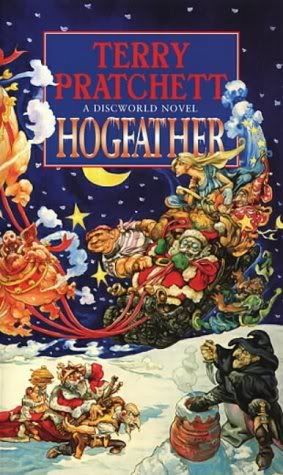
What Works: HOGFATHER by Terry Pratchett

Excerpt of Hogfather by Terry Pratchett

There was no doubt that whoever had shut it wanted it to stay shut. Dozens of nails secured it to the door frame. Planks had been nailed right across. And finally it had, up until this morning, been hidden by a bookcase that had been put in front of it.

"And there's the sign, Ridcully," said the Dean. "You have read it, I assume. You know? The sign which says 'Do not, under any circumstances, open this door'?"

"Of course I've read it, " said Ridcully. "Why d'yer think I want it opened?"

"Er...why?" said the Lecturer in Recent Runes.

"To see why they wanted it shut, of course."†


†This exchange contains almost all you need to know about human civilization. At least, those bits of it that are now under the sea, fenced off or still smoking.
The problem with trying to analyze humour is as soon as you try to determine what makes something funny, it stops seeming funny.

This is because surprise is an important part of humour. Humour consists of saying something that is recognizably true, but completely unexpected.

A joke's setup creates a scenario in the listener's mind.
An inebriated guest walks up to his host. "Mr. Hilcrombe, these lemons you've provided to flavour our drinks with are terrible!"

"What? I haven't provided any lemons."
The punchline twists the listener's assumptions in order to deliver an unexpected truth--an interpretation of that scenario that is valid, but a surprise.
"Oh, good heavens! Then I must apologize, sir; I've just squeezed your canary into my martini."
A simple knock-knock joke delivers a surprise interpretation of the answer to "Who's there?"
Knock, knock.
Who's there?
Esther.
Esther who?
The Esther bunny.
The final answer is unexpected, but it's a valid interpretation of the setup.

Satire--which is what Mr. Pratchett specializes in--consists of saying deeply critical things about our world and ourselves. What makes satire funny is most people won't say these things--either out of politeness or because they haven't thought about the matter that deeply. Thus, to hear the sentiments expressed aloud is unexpected.

When someone laughs at a crude and nasty joke, it's often because they didn't expect the other person to say something so socially discouraged. When they laugh at fine satire, it's because they didn't expect to hear such a deep truth expressed so incisively and, perhaps, so mercilessly. Cruelty isn't what ties these two different kinds of humour together, however; surprise is.

In the above excerpt, the punchline is in the footnote, the setup is in the text. Mr. Pratchett shows the reader a depressingly familiar scenario, and after reading it, the reader likely feels--in a vague sort of way--exactly the sentiment Mr. Pratchett is about to express coldly and incisively: Forget the cat; curiosity kills humans with regularity.

When Mr. Pratchett actually expresses this criticism of humanity, it's funny because we instantly recognize the truth in his words, but they're still a surprise. People don't usually say things so bluntly.

Most humour consists of this duality of recognition and surprise, although visual jokes don't always fit neatly into the definition. For example, in a skit from Monty Python's Flying Circus, John Cleese and Eric Idle are standing on some grass beside a body of water. Eric Idle slaps John Cleese across the face with a fish. The audience giggles because this is a surprising thing to see. But what truth is being recognized?

There isn't one, but the humour also isn't enormously funny--yet. As the skit progresses, Mr. Idle continues to slap Mr. Cleese in the face with the fish, and his body language gradually shifts from frightened to confident to arrogant as he does so.

Mr. Cleese simply stands there, staring in outrage at Mr. Idle. Then, just as the skit is becoming tiresome and Mr. Idle is mincing up to yet again slap Mr. Cleese, Mr. Cleese whips out a HUGE fish he had hidden behind his leg and wallops Mr. Idle across the side of the head, knocking him into the water. And the skit ends.

Now, the joke's setup and punchline are obvious. The setup was a series of minor outrages perpetrated against a blameless person. The punchline was straight-up vengeance. Who can't relate to wanting to give someone a taste of their own medicine, with accrued interest?

We recognize instantly why Mr. Cleese whacked Mr. Idle with the massive halibut, and our surprise comes from the fact we didn't expect him to do it; the skit hadn't primed us for anything except passivity from him.

IN SUMMARY:
What works in the above excerpt of Hogfather is the humour. The reader is shown a scenario under which lurks a deep truth about human nature. The punchline is provided when the author surprises the reader with that truth.

~~~~~~~

I'd like to do something different this week. Your thoughts (and dissent) in the comments section are always welcome, but for today's post, I'm assigning you homework:

1. Choose a piece of humour from any source (a book, a comedian's routine, a movie scene) and analyse why it's funny. What was the unexpected truth? Where did the surprise come from? Bonus points if you can do it for a piece of physical comedy; visual humour is often the hardest to decipher. Please post your analysis in the comments.

2. Using the concepts of truth-recognition and surprise, make up a brand new joke. Please post it in the comments section. (And if you require a straight man to pull off your joke, I'd be happy to act as your patsy!)

I look forward to seeing what you come up with!


Author website: J. J. DeBenedictis


And speaking of funny...

Monday, June 28, 2010

What Works: "2001: A Space Odyssey" by Sir Arthur C. Clarke


This week's "What Works" post focuses on an excerpt from Sir Arthur C. Clarke's 2001: A Space Odyssey, but here's my secret: This passage isn't part of the novel--it's taken from the foreword.

The reason why I focus on it will become apparent later.

Excerpt from the foreword of 2001: A Space Odyssey by Sir Arthur C. Clarke

Behind every man now alive stand thirty ghosts, for that is the ratio by which the dead outnumber the living. Since the dawn of time, roughly a hundred billion human beings have walked the Earth.

Now this is an interesting number, for by a curious coincidence there are approximately a hundred billion stars in our local universe, the Milky Way. So for every man who has ever lived, in this Universe there shines a star.

But every one of those stars is a sun, often far more brilliant and glorious than the small, nearby star we call the Sun. And many--perhaps most--of those alien suns have planets circling them. So almost certainly there is enough land in the sky to give every member of the human species, back to the first ape-man, his own private, world-sized heaven--or hell.

How many of these potential heavens and hells are now inhabited, and by what manner of creatures, we have no way of guessing; the very nearest is a million times farther away than Mars or Venus, those still remote goals of the next generation. But the barriers of distance are crumbling; one day we shall meet our equals, or our masters, among the stars.
The first time I read this, it literally made my scalp prickle as all the hair on it tried to stand up. I re-read the passage about three times before I dove into the novel itself.

Now why is that? There is every possibility the passage does not affect you the same way. This writing is skillful and potent, but the fact it affected me so powerfully is quite personal.

You see, I'm a science geek and a lover of science fiction and fantasy. Since childhood, I've been fascinated by our universe and all the possibilities that sit on the edges of what we understand. And holy tamales, this excerpt resonated with me. There are worlds enough for all of us? That thought has occurred to me as well.

Please bear with me; because I'm a geek, I'm compelled to define what resonance is according to scientists:
A body vibrates at some steady rate. If its vibration disturbs a second object, that second object may begin to vibrate in time with the first object. In fact, the second object may begin to vibrate very violently in response to the first.

This phenomenon is called resonance.


(Whether or not the second object vibrates at all depends on something called its natural resonance frequency, but we don't need to get into that here.)
So when I say something resonates with me, what I mean is it formed a pattern and I spontaneously echoed that pattern. Or, put another way, Sir Arthur expressed a set of ideas, and those ideas slotted into my head so perfectly it was as if I had been on the brink of thinking them up myself.

In other words, when I read this passage, I spotted the common humanity I shared with the stranger who wrote it.

There are few experiences as emotionally powerful as discovering a common humanity with someone else, even it it's through the filter of a piece of art. However, that experience is always personal. If you're someone whose passion is for abstract painting, or Judo, or immunology, it's entirely possible this excerpt would seem, at best, only mildly intriguing to you. It wouldn't fire your imagination the way it did mine.

Now the one thing that turns a book into a bestseller is word-of-mouth endorsements--people don't trust advertising, but they do trust a referral born of pure enthusiasm. And what provokes this kind of enthusiasm? Resonance. I'm convinced people only gush over books that resonated with them.

As an example of this, I think many are confused by the rampaging success of the Twilight books. These novels aren't high art, and they don't contain any particularly fresh elements ('cept for the sparkling.)

However, what the author got right is she utterly nailed what goes through the heart of a teenage girl at a certain age. Young women read these books and thought, "Yes. This is the boy I've been yearning for; this is the intensity of passion I've been dreaming of. I get this."

The story resonated with its target audience, and because of that, the audience turned evangelical on the story's behalf. A literary star was born.

But to people who don't dream of a boy like Edward Cullen? The books' popularity just makes no sense. The novels don't resonate with them.

In the above excerpt, Sir Arthur expressed his own thoughts and dreams, things personal and compelling to him. The fact that these things resonated with me--or with anyone--was a matter beyond his control. All he could do, as a writer, was to ensure he was mining fearlessly for his own truths.

It's ironic that to reach a wider audience, we have to ferret deeper into ourselves, but that's all a writer can do. You write the best damned book you can--the truest, most powerful, most emotionally-naked story you have inside you--and then you get it out into the world and hope like hell it finds an audience.

It might not, but then again, it might. That's what communication of any sort is about--conveying what's inside of you in hope that someone else will understand, that their mind and heart will resonate in sync with yours.

IN SUMMARY: What works in this excerpt (for me) is that it resonated with me. The writer captured his own thoughts and emotions, laid them on the page clearly, and in those words, I recognized my own thoughts and emotions and thus felt I had connected with another human being.

~~~~~~~

What books have resonated with you? Have you ever read something that stood your hair on end, and if so, what was it, and can you identify why it did that to you--you in particular? I'd love to hear your experiences.


Author website: J. J. DeBenedictis

Monday, June 21, 2010

What Works: "Snow Crash" by Neal Stephenson


This week's "What Works" post focuses on Snow Crash by Neal Stephenson.

Excerpt from Snow Crash by Neal Stephenson
The Deliverator belongs to an elite order, a hallowed sub-category. He's got esprit up to here. Right now, he is preparing to carry out his third mission of the night. His uniform is black as activated charcoal, filtering the very light out of the air. A bullet will bounce off its arachno-fiber weave like a wren hitting a patio door, but excess perspiration wafts through it like a breeze through a freshly napalmed forest. Where his body has bony extremities, the suit has sintered armorgel: feels like gritty jello, protects like a stack of telephone books.

When they gave him the job, they gave him a gun. The Deliverator never deals in cash, but someone might come after him anyway--might want his car, or his cargo. The gun is tiny, aero-styled, lightweight, the kind of gun a fashion designer would carry; it fires teensy darts that fly at five times the velocity of an SR-71 spy plane, and when you get done using it, you have to plug it into the cigarette lighter, because it runs on electricity.

[...*snip*...]

The Deliverator's car has enough potential energy packed into its batteries to fire a pound of bacon into the Asteroid Belt. Unlike a bimbo box or Burb beater, the Deliverator's car unloads that power through gaping, gleaming, polished sphincters. When the Deliverator puts the hammer down, shit happens. You want to talk contact patches? Your car's tires have tiny contact patches, talk to the asphalt in four places the size of your tongue. The Deliverator's car has big sticky tires with contact patches the size of a fat lady's thighs. The Deliverator is in touch with the road, starts like a bad day, stops on a peseta.
So who is The Deliverator? He's a pizza delivery boy--a pizza delivery boy in a world where corporations rather than countries rule the planet, and an employee failing to deliver his customer's pizza in thirty minutes may be out of a life rather than simply out of a job.

This excerpt shows off one of the most potent and enjoyable aspects of Neal Stephenson's writing: his voice.

Here's the power of that voice: Ask yourself how the protagonist (his name is Hiro Protagonist, by the way; har, har, Mr. Stephenson) talks to people. Ask yourself how he behaves around others.

At this point, you probably have a pretty good idea what this man is like to be around, and yet you haven't actually heard Hiro speak to anyone or seen him act. Your impression comes from Mr. Stephenson's writing voice, which he has tuned to match his protagonist's character. The cadences of Hiro's speech, the patterns of his thoughts, are mimicked here by the author.

You can tell Hiro takes a typically male delight in slick technology and high performance gadgets. You can tell he's cocksure, effortlessly cool, and takes a swaggering pride in how well he does his job.

But here's the big deception: take a look at the excerpts again. All of that is telling not showing.

What?! Doesn't that break one of the fundamental rules of writing? Oh, it totally does, but it also totally works. The first reason why is that we are being shown some important things. First: Hiro's personality. A braggart talks this way about himself, and we're learning about Hiro through witnessing this representation of his inner thoughts. Second: We're learning a lot about how seriously either Hiro or his employer takes the job Hiro is hired to perform; that's a lot of expensive gear he's got with him.

The second thing that helps redeem this long patch of "telling" is it is heavily laced with visuals, so even if we're not being "shown" Hiro, we're seeing a lot of images in our imagination.

...like a wren hitting a patio door...
...like a breeze through a freshly napalmed forest.
...feels like gritty jello, protects like a stack of telephone books.
...to fire a pound of bacon into the Asteroid Belt.
...gaping, gleaming, polished sphincters.
...four places the size of your tongue.
...big sticky tires...the size of a fat lady's thighs.


I will note the reason we see these things in our imaginations is they are not clichés. Each of these descriptions is apt, easy to imagine, and utterly unusual. And because each statement is an abnormal choice of words, we must imagine the image in order to understand what the author means.

In other words, the author has successfully engaged our mind in the world of the novel. If Mr. Stephenson had said, "His uniform is black as night, absorbing the light. A bullet will bounce off it like a pea, but excess perspiration wafts through it like wind through the trees", we possibly wouldn't picture a thing. The sentence would still be clear and understandable, but steeped in clichés as it is, our imagination could remain uninvolved with the process of reading the story.

The last thing that keeps this excerpt highly readable is, again, the quality of the writing voice--the pure charisma of it. We are listening to Hiro's mind talk, but that speech is flamboyant and energetic and laced with many funny and wonderful visual images. It's a captivating voice. This is somebody you would gravitate toward at a party--even if he was someone you didn't actually like.

The reason why we writers are told to "show", instead of "tell", is because most people "tell" by default when they begin writing fiction, and they usually don't do it very well. By learning to "show", they then become much more effective at engaging the reader's imagination.

But Mr. Stephenson proves something we writers often forget or try to disbelieve--that "telling" works when it's done by a skillful enough storyteller.

The aim of writing fiction is to slurp the reader into the story, to engage their imagination, and to keep the reader so well-rewarded for their attention that they can't put the book down until the last page. As long as the author does this, the tools he or she uses are immaterial. "Telling" is just another tool--a dangerous one in the hands of amateurs, but as effective as "showing" in the hands of a master.

In order to "tell" effectively, you need (1) a genuinely charismatic voice, (2) fresh language that engages the reader's senses and imagination, and (3) you need to be laying down important information.

The reason why first person POV is very, very hard to do well is because everything gets filtered through the protagonist. There is necessarily a lot of "telling" required to convey the world of the novel to the reader, and often the writer doesn't satisfy the three points above or doesn't do so consistently throughout the novel.

My least favourite encounters with first person POV in novels are when I find myself deluged with unimportant information such as how the protagonist looks or dresses or how hot they think their friend is. Is this character someone I would gravitate toward at a party? No, it's the yatterer who won't shut up about themselves and their own slight concerns--the person I try to avoid.

In the above excerpt, we learn how Hiro is dressed, but it's relevant information. It establishes what his job is like, what his world is like, and it sets the novel's tone. It also gives Mr. Stephenson opportunity to throw in some of his wonderful "eyeball kicks" (eyeball kick: those abrupt, specific images you experience while reading a very visual piece of writing.)

The description of Hiro's clothing is also quite brief. The difference between a good writing voice and an annoying one is often a matter of degree--if you can imply all the information you need in one sentence, then do it.

If you're not sure how much patience your reader will have for your protagonist's inner thoughts, the rule of thumb is, "Would I attach myself to the elbow of a person who talked like this at a party, or plot my escape from them? Especially if I didn't know them at all?" Often you can determine when it's time to shut your protagonist up and get on with the action based on that criteria alone.

IN SUMMARY: What works in this piece is the strength of the writing voice, which is a combination of potent visuals, cliché-free writing, and the establishment of the protagonist's native charisma.

~~~~~~~

What do you think makes this piece engaging? Is there anything about it that turns you off? Do you agree with me that Mr. Stephenson is "telling" rather than "showing" here?

Do you agree with my criteria for what makes "telling" engaging? What would you add to my list? Subtract from it? Do you disagree with my comments about first person POV? I'd love to discuss it with you.


Author website: J. J. DeBenedictis

Wednesday, June 16, 2010

What Works: Arthur Golden's "Memoirs of a Geisha" (A New 'Meaty Mondays' Series)


A week-and-a-wittle ago, Sarf had a fantastic suggestion for my "Meaty Mondays" posts. He encouraged me to post story excerpts and discuss what works or doesn't work in a particular passage.

Now, I'm of the opinion there's far too much negativity in the world because negativity is easy. It's always harder to pin down what is magical and awesome than to spot what's wrong. Thus, this series of posts will feature an excerpt of writing, then discuss in detail one thing that passage does right.

We're all about positivity here! And also about figuring out what to do, rather than what not to do.

This week's Meaty Monday post (I postponed Monday) will discuss in detail an excerpt from Arthur Golden's book Memoirs of a Geisha.

Excerpt of Memoirs of a Geisha by Arthur Golden
I didn't know it at the time, but after the closing of the lens factory where she'd worked, Pumpkin spent more than two years in Osaka as a prostitute. Her mouth seemed to have shrunken in size--perhaps because she held it taut, I don't know. And though she had the same broad face, her heavy cheeks had thinned, leaving her with a gaunt elegance that was astonishing to me. I don't mean to suggest Pumpkin had become a beauty to rival Hatsumomo or anything of the sort, but her face had a certain womanliness that had never been there before.

"I'm sure the years have been difficult, Pumpkin," I said to her, "but you look lovely."

Pumpkin didn't reply to this. She just inclined her head faintly to indicate she'd heard me. I congratulated her on her popularity and tried asking about her life since the war, but she remained so expressionless that I began to feel sorry I'd come.

Finally after an awkward silence, she spoke.

"Have you come here just to chat, Sayuri? Because I don't have anything to say that will interest you."

"The truth is," I said, "I saw Nobu Toshikazu recently, and...actually, Pumpkin, he'll be bringing a certain man to Gion from time to time. I thought perhaps you'd be kind enough to help us entertain him."

"But of course, you've changed your mind now that you've seen me."

"Why, no," I said. "I don't know why you say that. Nobu Toshikazu and the Chairman--Iwamura Ken, I mean...Chairman Iwamura--would appreciate your company greatly. It's as simple as that."

For a moment Pumpkin just knelt in silence, peering down at the mats. "I've stopped believing that anything in life is 'as simple as that,'" she said at last. "I know you think I'm stupid--"

"Pumpkin!"

"--but I think you probably have some other reason you're not going to tell me about."

Pumpkin gave a little bow, which I thought very enigmatic. Either it was an apology for what she'd just said, or perhaps she was about to excuse herself.

"I suppose I do have another reason," I said.

Arthur Golden's Memoirs of a Geisha is beautifully written and evocative, but the above passage is also a textbook-perfect example of how to structure a scene.

It's so classic, in fact, that I'll analyse it the way Robert McKee suggests in his screenwriting book Story.

In that book, Mr. McKee notes that your protagonist needs a goal and she should take action in hope of getting closer to her goal. However, each action she takes should be met with a reaction from the world that is not what the protagonist expected.

In some cases, 'the world' is in fact another character, and that character's reaction to your protagonist is what thwarts the protagonist's hopes. This is because the second character has a goal that conflicts with your protagonist's.

Mr. McKee goes further; he says each time your character is thwarted from getting to her goal, she should take another action to try to fix that. However, this second action must necessarily involve more risk to the character.

In other words, the character first tries to do the easy thing to reach her goal, and when that doesn't work, she must try something harder/riskier. When that also fails, she then has to risk herself even more, and so on with each subsequent failure to reach her goal.

Thus, in a scene with two characters in conflict with one another, such as in the example above, there is escalating tension. The two characters must slowly risk themselves to greater and greater extents as they try to bend the situation to their will.

This progresses up to the scene's turning point, where something happens that changes the situation irrevocably. This usually means the characters have pushed themselves to the limit and something has finally snapped--perhaps someone blurted out a damning fact, or took an unforgivable action, or maybe they simply made a firm decision that will propel both people in a new direction. I cut off the above scene right before the turning point.

So what are Sayuri and Pumpkin's goals? First, let me explain a bit of their backstory so you understand the stakes.

As teenagers, Sayuri and Pumpkin trained together to become geisha, but World War II split them. Now Sayuri has returned to being a geisha, and she was recently asked by a man she secretly loves (the Chairman) to entertain a business associate who happens to be a very crude and stupid man. Sayuri dreads this, and she wants Pumpkin--who she perceives to be more earthy than herself--to help her entertain the business associate.

However, Sayuri's success as a teenaged geisha came very starkly at the expense of Pumpkin's--a fact that Sayuri either doesn't fully recognize or optimistically hopes won't matter now. Pumpkin, however, is both aware and resentful of it.

Thus, in this scene, Sayuri's goal is to enlist Pumpkin's help, and Pumpkin's goal is to give Sayuri nothing and, in fact, to get rid of her.

Let's now analyze the scene by outlining the actions and reactions of the characters, paying particular attention to the subtext of the situation. ("Text" is what the characters actually say; "subtext" is what they really mean.)

As we go through the dialogue, you'll note the characters do risk themselves to greater and greater degrees as the scene progresses. Specifically, they begin to tell the truth, and in doing so, they expose their real feelings. For individuals steeped in the social anxiety and stiflingly-polite culture of Japan, this is risky behaviour.

SCENE ANALYSIS

Sayuri: I'm sure the years have been difficult, Pumpkin, but you look lovely.
Subtext: I'll gloss over the awful events of the war and compliment you to rekindle our friendship.
Expectation:
Our meeting will go happily and you'll do me this favour.

Pumpkin: (nods)
Subtext: You don't really mean that compliment, and I don't really want you here.
Expectation:
You'll take the hint and stop intruding on my life.

Sayuri: (Congratulates her on her popularity, tries asking about her life since the war)
Subtext: The compliments don't seem to be enough... Alright, I'll still avoid the unpleasant war years, but I'll take more interest in your life.
Expectation:
You'll remember we used to be friends and soften toward me.

Pumpkin: Have you come here just to chat, Sayuri? Because I don't have anything to say that will interest you.
Subtext: You don't seem to be taking the hints, so I'll be a bit more obvious. I don't want to be your friend, and I can't believe you want to be my friend.
Expectation: You will back off.

Sayuri: The truth is, I saw Nobu Toshikazu recently, and...actually, Pumpkin, he'll be bringing a certain man to Gion from time to time. I thought perhaps you'd be kind enough to help us entertain him.
Subtext: Okay, I'll be honest--wait, no, maybe not completely. But I'll open up about the fact I'm here to ask a favour.
Expectation:
You'll be nice once you hear this very reasonable request from your old friend.

Pumpkin: But of course, you've changed your mind now that you've seen me.
Subtext: I've been a whore for two years. I disgust myself; I must disgust prissy little you. So how about I make it easy for you to wiggle out of this conversation? I certainly want you gone.
Expectation:
You'll be offended and embarrassed by my bluntness and make your exit.

Sayuri: Why, no. I don't know why you say that. Nobu Toshikazu and the Chairman--Iwamura Ken, I mean...Chairman Iwamura--would appreciate your company greatly. It's as simple as that.
Subtext: I'll chide you a little on your rudeness, but I'll also be a bit more honest about why this is important to me. However, I must keep my feelings for the Chairman secret.
Expectation:
You'll realize you're being unreasonable.

Pumpkin:
I've stopped believing that anything in life is 'as simple as that,'
Subtext: What a load of B.S. You are totally up to something.
Pumpkin: I know you think I'm stupid--
Subtext : I know the disdain you've always felt for me.
Expectation: I'm going to go on the offensive, and you will back off.

Sayuri: - Pumpkin!
Subtext: Why is this not working? Why would you think I'd think such a terrible thing about you?

Pumpkin: --but I think you probably have some other reason you're not going to tell me about. (Pumpkin bows, perhaps signaling she intends to leave.)
Subtext: So there. I'm smart enough to see through you and will never let you use me again.
Expectation: The truth in my rebuke is going to scare you off, but even if it doesn't, I'm ending this conversation now.
Note: This is an example of 'on the nose' dialogue, but it works well here because telling the truth is the riskiest behaviour in this situation/society. Pumpkin has pushed herself to the limit to get what she wants.


Sayuri: I suppose I do have another reason.
Subtext: OMG, she's leaving. I have to be honest now; nothing less is going to work.
Expectation: I can still win this if I try just a bit harder.
Note: And now Sayuri pushes herself to the limit too. The turning point of the scene comes right after this.


Notice how every step of the way, these characters are digging deeper into themselves to get what they want. They start out with a very superficial interaction, both of them anticipating an easy resolution, but by the end, they're--so to speak--going for the nuclear option: they're speaking the unvarnished truth.

Also note how much I wrote in the form of subtext compared to how much the characters actually say. Good writing implies volumes using very few words. These sentences have been pared down to say exactly what the author wanted to in as concise a way as possible. Each word is precise and carefully chosen with regard to nuance.

Another interesting point is that if you speak this dialogue aloud, the exchange wouldn't last much longer than 60 seconds. That's a pretty short conversation, isn't it? The fact is, dialogue isn't like real human speech. When done well, it is convincing as such, but people don't talk like this. The writer has a luxury of time to finesse his or her sentences into concise, eloquent perfection; real people just can't think that fast.

SUMMARY: What works best in this passage is the escalating tension caused by each of the characters trying ever-harder to get what she wants in the face of opposition.

~~~~~~~

Have you any comments to add to this? What else do you think works well in this passage? Is there anything you think doesn't work? I'd love to hear your thoughts!


Author website: J. J. DeBenedictis

Pageloads since 01/01/2009: