Saturday, May 29, 2010

Hee!

Now that Peter Dudley's contest is finished, I can show off my entry. The contest was to make up both a name and a label for the home-brew beer Peter intends to drink in his hot tub with his buddies as they watch the World Cup.


I felt pretty pleased with how this turned out. The beer name was a variation on "Winkle's Old Peculiar" from the Diskworld novels, but then Peter suggested adding "and" between "Old" and "Peculiar", and I really liked the additional ambiguity (i.e. is that " 's " possessive, or is it short for "Dudley is..."?)


Author website: J. J. DeBenedictis

Tuesday, May 25, 2010

Kung Fu Bear...

...needs no further introduction. The fun stuff starts at about 25 seconds into the video.


The bear's name is Cloud and s/he resides at the Hiroshima Zoo.

Link found via Geekologie.

Author website: J. J. DeBenedictis

Monday, May 17, 2010

"You are no chicken. You are an Eagle. One day you will soar."

Great post over on Ello's blog. Although it's titled "Random Funny Things My Mom Says", the advice is more heart-warming than humourous, and it's something I'm glad I heard:
From Random Funny Things My Mom Says--Part 7 by Ellen Oh

"Listen, don't be stuck on your book. Let it go and be happy. When you are happy, really happy, then go back to it. Nothing works when your brain is filled with stress." She rubs at the crease between my eyebrows. "Your brain is all filled with worry and stress and miserableness. Why you want to put that in your book? You put that in your book - who want to read it? Happiness makes you healthy. Healthy makes your brain happy. Then you write your book."


Author website: J. J. DeBenedictis

AH-HA-HA-HA-HA-H--wait, it's not serious, is it?


Image from Geekologie.

Author website: J. J. DeBenedictis

Monday, May 10, 2010

Ethics and E-Publishing

Both Courtney Milan and Stacia Kane blogged this week about their disquiet over literary agents getting into the e-publishing game.

We're not talking about scam agents, by the way--this involves reputable literary agents/agencies with established track records of sales to large publishers.

Case A: Lori Perkins has a financial stake in the e-publisher Ravenous Romance.
Case B: The Waxman Agency is opening an e-publishing house called Diversion Books.

Neither Ms. Perkins nor The Waxman Agency belongs to the Association of Author's Representatives, which has a canon of ethics that states: "Members shall not represent both buyer and seller in the same transaction." That said, an agent doesn't need to belong to the AAR to be reputable; my former agent wasn't, and she was awesome-sauce with sprinkles on top.

However, most agencies that are reputable pretty much abide by that canon of ethics anyway. By getting into e-publishing, however, these two seem to have stepped outside those bounds.

Ms. Milan and Ms. Kane had some excellent points to make about this, and I recommend you click the links below and read both their posts:
From "On Self-Dealing" by Courtney Milan

Lori Perkins has explained that she doesn't take a commission on those sales to Ravenous from her clients--but all that this accomplishes is that now she truly has no financial interest in doing what is right for her clients. She has no interest in fighting for an extra 2% royalty rate, or a higher advance for her clients, because now she isn’t [...] getting paid for that.
From "It's Just Upsetting" by Stacia Kane

I honestly believe [Scott Waxman] thinks he's doing the absolute best for his clients. But why start up an epublishing imprint, thus creating a conflict of interest and a breach of AAR ethics? Why not submit your clients to an existing epublisher, or small press [...] if the project isn't right for NY? Isn’t an agent supposed to keep trying until the project sells, even if it's to a smaller house?
I would like to stress, for anyone who didn't read the full blog posts, that I excerpted some of the blunter statements made. Ms. Milan and Ms. Kane are both very respectful of Ms. Perkins and The Waxman Agency and state firmly that they believe this agent/agency is reputable. I believe that too.

If you did read the posts, however, you'll have noted there's a certain amount of tip-toeing going on, and I'm going to tip-toe also--and for the same reasons: I don't want to be black-listed by agents.

But that wariness is part of why I feel compelled to speak up. Because major publishing houses don't take un-agented submissions, literary agents are in a position of power over writers, and it's not an irrational fear for me to wonder if having a valid-but-unpopular opinion would hurt--or even abort--my writing career. The stakes are high if I open my mouth to complain about literary agents.

That imbalance of power is exactly why we need to scrutinize literary agents, however. Anywhere there is an imbalance of power, there is the possibility of abuse, and the number of scam agents already in operation is a testament to that. We writers do need to stay aware of what reputable agents doing, and get vocal when they do something that puts them on the slippery slope from reputable to disreputable.

However, I still don't want to shoot myself in the foot, so I'll say only the following, and I'll keep it general:

An agent takes a 15% commission on a writer's earnings. The only way this relationship is symbiotic is if
a) the agent only makes money from the writer's work when the writer themself does, and
b) the writer makes more money with the agent's help than they would have made without it.

The moment either of those conditions ceases to be met, the relationship changes from a symbiotic one to a parasitic one.

If the agent makes money off the writer regardless of whether the writer is making any money, then the agent can't be trusted to have the writer's best interests at heart any more. The agent has less incentive to do their job well if their paycheque is already assured.

The situation becomes even more problematic when the agent stands to make more money from the writer making less money. This is exactly the situation that exists when the agent owns or has a financial stake in a publisher. The agent stands to make more money (as a publisher) from the writer getting a less lucrative deal, and it's an obvious conflict of interest for the agent to have a monetary incentive to do their job (as an agent) poorly.

~~~~~~~

What do you think of this? Agents want to help great books get published, and I can see how an agent might aspire to move into publishing in order to see this happen. How do you think such an agent should handle doing so, if they want to make sure they stay within the boundaries of ethical business conduct with regard to their agenting?

Would you consider signing with a reputable agency that had an e-publishing arm? Just because the owner of the agency also owns an e-publishing house doesn't mean the other literary agents at that agency are getting a cut of the e-publisher's profits. As long as the boss isn't exerting undue influence on his or her agents, those agents don't have a conflict of interest.

Finally, what about agents who are also writers? It can be argued they have a conflict of interest too, if one of their clients writes a book that would compete with the agent's book. How do you think that situation should be handled? Do you have reservations about signing with an agent who is also an author?

Anonymous commenting is on, if you have an opinion-bomb you don't want to catch any shrapnel from. I would love to hear everyone's (especially agents') thoughts.


Author website: J. J. DeBenedictis

Wednesday, May 05, 2010

Proud To Share the DNA

Can I just take a moment to be a very proud sister? My siblings, Sarf and Heather, take some awfully gorgeous photos.

Here are a few shots of the unforeseen complications that came after my sister and her husband took in a stray cat:


Click this link to see the rest of the Kittehpile (also featuring my sister's awesome digital scrapbooking skills.)

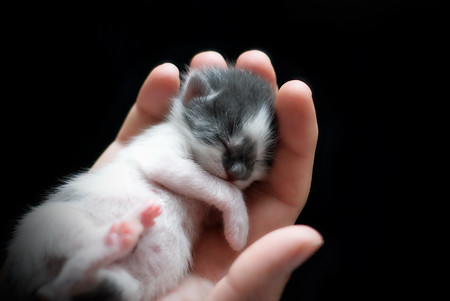
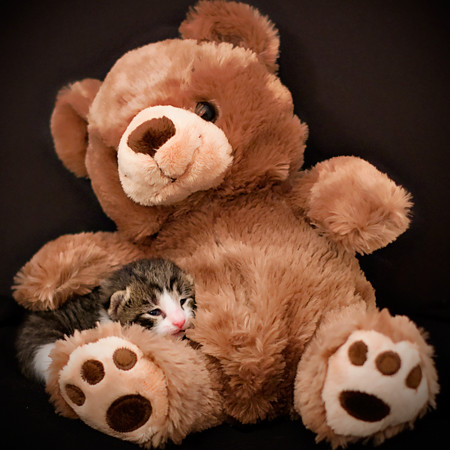
Let me know when you're done melting into a warm puddle of goo and we'll continue. Okay, then? Okay.


Here are a few shots from my brother's trips to, respectively, the Icelandic volcano that hates England so much, and sunny, wonderful Mexico (which the volcano tolerates):


Click this link to see more Mexico shots. The volcano shots start here and you'll have to navigate thereafter.

Izzat gorgeous or what? They're both so incredibly talented!


Author website: J. J. DeBenedictis

Writing Advice from Dave Cullen, Author of "Columbine"

Many of you probably already follow the blog of Rachelle Gardner, literary agent, but I thought this post containing writing tips from Dave Cullen, author of Columbine, to be particular astute and useful.
Excerpt from Writing Wisdom from Dave Cullen

The book Columbine involves a large number of characters—students, teachers, parents, law enforcement, doctors—but the amazing thing to me is that I never once got confused about characters or lost track of who was who. Dave says the way to achieve this is to introduce each character in a memorable fashion. When they first appear in the book, they must be portrayed in a vivid, visual way that the reader cannot forget.


Author website: J. J. DeBenedictis

Sunday, May 02, 2010

Open Wide...

I'm not sure if this is someone's idea of hell or of heaven. A cupcake cannon:


Link found via Geekologie.


Author website: J. J. DeBenedictis

Yes, I'm Close Enough.

This guy should be taking lessons from the fellow in the video below.

For the metrically-challenged, 3 centimetres equals 1.2 inches.


Thanks to QuirkyJessi and FairyHedgehog for the link!


Author website: J. J. DeBenedictis

Saturday, May 01, 2010

Squee!

I won a contest!

A small contest, featuring very small stories (200 words maximum) about small things (the theme was "micro"). You can read all the entries by following the "AE Micro" link on AE Science Fiction's website.

And, if you're feeling generous, you can help this new Canadian speculative fiction magazine get off the ground by clicking here and pledging them a few dollars. I donated back my payment for the story, and I wish AE a successful and illustrious future!


Author website: J. J. DeBenedictis

Friday, April 30, 2010

Am I Close Enough Yet?

How not to park in a parking garage:


Image via Geekologie.

Author website: J. J. DeBenedictis

Wednesday, April 28, 2010

Social Media, or How To Not Be a Dork Under Your Own Name

BookEnds, LLC had a post about using social media this week that was, as usual, well-thought out and interesting, but it's the discussion in the comments I found particularly great. And it provoked the following blog post wherein I try to find the line between having fun on the internet--and not shooting yourself in the foot for having had fun on the internet.

What Happens on Google Stays on Google...and That's a Problem


I think we all realize you can embarrass yourself on the internet. Badly. What not as many people realize is you often can't delete the evidence as completely as you think.

If Google's web crawlers have been by to index a particular webpage, they store a copy of that page as backup, and any person who knows how to use Google Cache can look at the backup.

Which means if you just deleted or put a privacy lock on some embarrassing entry on your blog or LiveJournal, the backup still exists and is completely accessible.

The moral of the story is: What happens on Google stays on Google. If the web crawlers have seen it, you are no longer in control of it.

And this says nothing of drama-hounds who screen-capture things that look controversial, or archives like the Wayback Machine that seek to preserve our online cultural artifacts.

The internet is more than just a public place; it's a public place that other people can show up to retro-actively. Don't assume that just because only three people read your blog today, only three people ever will. If one of those three people links to your post in the right forum, ten thousand people could show up tomorrow to have a peek at what you said.

But...When Did We Forget Our Dreams?


The post at BookEnds discussed the idea that authors need to be careful about their online image. You don't want to offend people, and you also don't want to bore them with endless stories about your cat.

But I'm really of two minds about this. On one hand, I heartily agree with the sentiment behind this XKCD comic, which is in disagreement with what Jessica at BookEnds said:
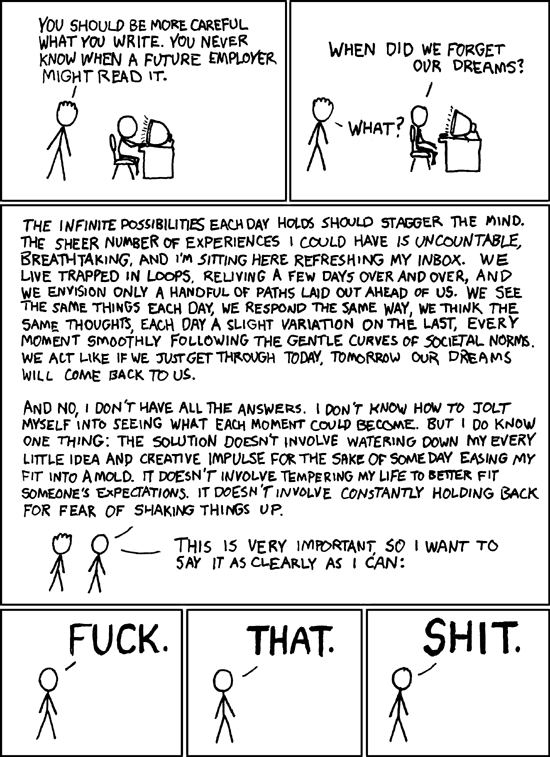


As writers, we should not censor ourselves. We are here to SPEAK. We are here to communicate what is in our heads, not to stifle ourselves for fear of losing someone's esteem or losing money. We're supposed to be courageous and loud-mouthed, and as artists, we're ALLOWED to have personality.

But on the other hand, I have seen many, many people make themselves look like idiots on the internet, and I have managed that trick personally faaaaaar too many times. I understand what Jessica at BookEnds is worried about, and I believe the answer to our problem is...

Practice Safe Freakishness.


If you've got online hobbies, engage in them freely and fearlessly--enjoy the heck out of yourself. The awesome thing about the internet is you can easily find people just as gloriously weird as you, so go ahead and do so! Live your life, and not in fear.

Just do so under a pseudonym. The world can always use another steelravynn777, amirite?

Keep your hobby-life strictly separate from your real name and your 'real' online life. Create a different email account; create a separate blog. Never include any correct personal information when you sign up for an online journal you intend to use for your hobby, and minimize the amount of information such websites show publicly in your profile.

This won't necessarily protect your identity from a determined internet sleuth; some people are malicious, and some of them are extremely smart with computers. However, if you refrain from really ticking people off with your internet shenanigans, you're not likely to run afoul of such a person. (No guarantees, however; see above comment about maliciousness.)

I personally feel no guilt about this sort of stealthiness. I have a right to be a weirdo, and I also have a right to determine who knows that. For example, it isn't my boss's business what I do in my spare time, so I am perfectly comfortable safe-guarding that information from him.

My final thoughts have to do with the matter of your 'real' internet presence--i.e. the one you do want associated with your professional name.

Remember That You're At Work


If you're trying to build an online presence to serve a business interest--such as building your brand if you're an author, a literary agent, or a small business owner--then you need to remember that when you post, you're at work.

And at work, you behave professionally and you keep your mind on the job.

So what is your job? This needs some defining.

I'll first reiterate a distinction I've made on the blog before because I think it ties into this discussion:

Anyone can write, and what they write is valid art and valid expression.

However, if you're seeking publication for your writing, then you need to realize you are writing for other people. It's not enough for you to enjoy what you've written; the book is not publishable unless hundreds, or thousands, of complete strangers will enjoy it too.

So how does this relate to the discussion here? Like so:

If you're using social media to build your business interests, it's not enough for you to be entertained by what you say. What you're aiming for--what your 'job' is--is to convince hundreds, or thousands, of complete strangers that you have engaging, interesting or funny things to say.

If you're a non-fiction author, your job is 'educator'.

If you're a novelist, your job is 'entertainer'.

There is overlap between the two, and a lot of room for fuzzy definitions, but that's the core of it. When you log in to create a post under your professional name, you should be striving to either interest or entertain people.

People who are not you! Who may not even be like you. And that's the tricky issue, because if you've been engaging in online hobbies, you're very used to creating posts that are mostly for your own entertainment. Those kinds of posts usually entertain others too, but they can also be self-indulgent.

And I think that's the distinction Jessica at BookEnds is trying to get across to her readers. It's self-indulgent to go off on a political rant; it's self-indulgent to natter about how cute your cat is. Those kinds of posts are not aimed at entertaining or educating others, so they shouldn't show up under your professional name. Put those posts on your hobby-blog, not your professional blog.

One very interesting point discussed in the comments of the BookEnds post is how much personality a writer should let seep into their posts. The answer is: exactly as much or as little as you want, provided you are entertaining people.

You can have hilarious mom stories like Ello provides, and you can have wistful dreaming-out-loud like I'm Not Hannah.

The acid test is whether you think other people will enjoy or appreciate them. It's not enough for the post to merely be something you really want to say--not on your professional blog, at least--it has to also be something other people are interested in hearing.

~~~~~~~

Did your last post survive the acid test? Do you agree or disagree with the distinctions I've made? Where do you think the line between private and professional should lie, and how much of your personality are you comfortable splashing out there for the world to see?

What things would you never talk about on the internet? What sorts of things are out there already that you wish weren't? Do you worry about what your kids have put out there?

I'd love to hear your thoughts!


Author website: J. J. DeBenedictis

Friday, April 23, 2010

Ouch.

So, I no longer have a literary agent.

I half-way knew when I sent her my latest novel there was strong chance my agent wouldn't want to represent it. This book is very dark and quite a departure from the one she signed me with. Thus, the news last night was a disappointment, but not a shock.

My experience of working with Eleanor Wood has been nothing but positive. I highly recommend anyone who writes science fiction or fantasy to query her; she's a lovely woman--warm, professional and dedicated--and a responsive agent. Any time I had a question, she always got back to me promptly. Her comments on my work were both supportive and incisive, and I valued her feedback.

Plus, she found an editor at Tor (I mean, like, Tor. Tor! Squee!) who wanted to make an offer on my first novel. If the economy hadn't tanked at an inopportune moment, I probably would have been able to celebrate publication this year. You can't ask for better than that.

So I'm a little sad now, but still hopeful. If I did it once, I can do it again, and I am nothing if not bull-headed. This is a setback only.

Plus, as these photos show, there are bigger problems a person could have. I've got a wonderful life, and I'm thankful even to have a shot at getting published--the luxury to strive for more than just the necessities of life is a great gift.

But dang--does this mean I have to write another query letter?!?

Thanks to Writtenwyrdd for the link to volcano photos! Aren't they gorgeous?


Author website: J. J. DeBenedictis

Thursday, April 22, 2010

PARTY--er, I mean-- CONTEST AT ERIC'S PLACE!

I don't know how I managed to over look this, but blogging-buddy Eric is running a seriously-awesome contest with a seriously-awesome prize--a critique of your first ten pages or of your query letter by Elana Johnson or a copy of Ms. Johnson's book, From The Query To The Call.

Free stuff or a critique? I don't even know how the winner will decide. Now that you know what we're clamouring for, what exactly is the nature of the contest? I'll let Eric himself tell you:
You can relate a funny story involving a real celebration or you can make up something completely fictional. It can be short or long, any genre. If you don't want to put it into the comments section, email it to me at estallsworth@comcast.net. Just make sure you put in a comment mentioning that you did that. I will then randomly select a winner.
Randomly!?! Kids, we don't even have to be good at this to win! WHOO-HOO! Contest deadline is April 30th, so lick your pencils and get scribbling!


Author website: J. J. DeBenedictis

Sunday, April 18, 2010

Are You Feeling It Too?

The single most valuable new thing I learned at SiWC 2009 was that the way to make your readers care about your story is to ensure your characters care.

Human beings feel empathy; we care about what others are going through. Thus, to hook your reader by their heart, your characters need to care deeply about the events of the story. Their emotional investment invites a similar investment from the reader.

Here's an example:
Liz is an untreated haemophiliac who is trapped in a cabin due to a blizzard. She gets a paper-cut. She decides not to panic. She binds the wound tightly, then remains still and calm while she waits out the blizzard.
Alternately:
Liz is an untreated haemophiliac who is trapped in a cabin due to a blizzard. She gets a paper-cut. As she watches the blood ooze out, horror makes her scalp prickle. She begins to shake, and then to cry with fear. Her mind scurries, trying to think of a way for her to get to civilization now, so this can be dealt with.
A story starting with the second scenario would be more likely to hang onto its readers, not because Liz has become a more likable protagonist (she hasn't) but because she cares deeply about what has happened. Her panic, if not her plight, is something the reader can empathize with.

I have a tendency to not sink my reader into my characters' heads deeply enough, and so I worry about whether I'm effectively showing how much my characters care about what's happening to them. I don't know if this tendency is due to me being hard-wired for visual stimuli (the way I think about scenes is very cinematic) or that I'm taking the "show, don't tell" principle too far. Rather than exploring what a character is feeling, I often try to show it with their physical reactions. You can see that in my example above.

That's not necessarily wrong or right. On one hand leg o' the chicken, the strength of books is that you can dive right into a character and know exactly what's going on in their head and heart. That doesn't happen quite so directly in any other art form.

On the other hand feathery shank, however, saying what someone is thinking or feeling is 'telling', and thus boring. If you're going to do it, you need to do it well.

Orson Scott Card does it superbly in his book The Crystal City. He made me positively loathe the villain simply by dumping me into the villain's head for a while and letting me see how the guy thought. Guy Gavriel Kay did it just as effectively in Sailing to Sarantium with a brilliant chariot race scene. At the beginning of the scene, you've never met these people before. By the end, you're on the edge of your seat because you know how deeply each of the characters cares about the race--only one of them is really in danger of losing his dreams, but all of them are in an emotional frenzy, and you can't help but be swept up in it.

So to get your reader to care about the story, make certain the characters care about it--and deeply--and that they are seen to care.

The tricky question is how to accomplish this.

In both Mr. Card and Mr. Kay's aforementioned books, the technique was to get deep into the characters' points-of-view. The audience was reading the character's thoughts exactly as they occurred to the character himself. There was no extra layer of analysis on the part of the author; the reader was getting an undiluted chance to mind-read these fictional people.

In contrast, my technique of describing how a character physically reacts keeps the reader completely out of that character's head--and yet, I can still communicate what the character is feeling and how much they care about the situation. It's not wrong, but it's also not necessarily the best way to do this. I should probably treat it as one tool in the toolbox, and work on acquiring other tools also.

My personal belief regarding putting the reader inside the character's head is that the deeper into the point-of-view you go, the more you are "showing". This is a strength, in my opinion. The text should read like a transcript of the character's thoughts, and the writer's art goes into making sure those thoughts communicate the character's emotions too.

The more the text reads like a description of what the character is thinking--i.e. the shallower into the point-of-view the writer takes the reader--the more the writer is "telling". I find this ineffective, but when your chosen point-of-view isn't first-person, it's often necessary.

~~~~~~~

How do you show how much your characters care about what's happening to them? Do you describe their physical reactions? Do you insert the reader into the character's head? Do you use a combination of the two? Do you use other techniques entirely?

What technique do you think is most effective, and why? Do you find one of the techniques harder than the others? Do you find you tend to gravitate toward one or the other naturally?

Finally, what do you think are the pitfalls of each technique? Where and how do you think writers fail when they employ them? What can they do to improve their effectiveness at hooking the reader's emotional interest?


Author website: J. J. DeBenedictis

Saturday, April 17, 2010

Taking Out the Garbage

This is a really thought-provoking and fantastic article by Jennifer Crusie about how a writer's work happens in his/her head, and thus you need to watch how much time you spend thinking about things that aren't on your list of priorities.

From Taking Out the Garbage:
Did you get caught up by somebody else’s indignation on the Internet, firing off e-mails of your own and fuming at the unfairness of life instead of writing about it? If that’s where you wanted your emotional and creative life to go, you’re in good shape. If it isn’t, get over whatever it was that stole your mind and get back to where you want to be.


Author website: J. J. DeBenedictis

Sunday, April 11, 2010

Thank You, Intrepid Beta-Testers! | What? Huh? Print Rights Are the New Subsidiary Rights?

First, a huge thank you to all of you who beta-tested The Book Trailer Project. As of tonight, the last of the fake books has been auto-removed, and the statistics for the trial run are available here.

Thanks especially to FairyHedgehog, who gave me lots of feedback, and Josh Vogt, who not only was game enough to create a book profile and upload it, but who also asked if there was anything diabolical I would like him to do to stress the system. I very much appreciate it, both of you!

Eurgh. But you know what this means? It means I now have to go to the (scary) next step of convincing published authors to upload their book materials to the site and then try to entice large numbers of strangers to browse for stuff there. Whoo-hoo, and OMG-what-have-I-gotten-myself-into. Certainly, if any of you know a published author who would like some extra free publicity, please direct them either here (so they can stalk me and convince themselves I'm not a psycho), or to The Book Trailer Project's home page.

Thank you in advance, if you do!

~~~~~~~

This article by J. A. Konrath is one of the most thought-provoking things I've read about e-publishing in a while--probably because he is not a convert to self-publishing, but he does have some interesting monetary facts to note and is feeling fairly conflicted about them.

The short version of the article is he put some of his early books--ones that had been rejected by major publishers--on Amazon for $1.99, and he's now making about $125 per day selling them. And this has provoked a crisis of faith in him, because he's always advised new writers to go the traditional route--get an agent, sign with a major publisher, do not self-publish. But he's making a non-trivial amount of money by essentially self-publishing.

I'm not sure what to think of this either. I do agree with him when he says:
[I]f you're a writer, and you're changing your career path based on a blog, you aren't thinking long and hard enough about this business.

I've walked the walk for a long time. Your mileage my vary. Don't give up your agent search because I'm pondering aloud about the future. Don't rush to put your stuff up on Kindle without fully understanding and weighing the potential costs vs. benefits.
(Emphasis mine.)

The reason for Mr. Konrath's reticence is he is definitely a self-publishing exception. He already has a brand, one he has spent years creating in conjunction with traditional publishing, and that is NOT something most self-published authors get. He also has the experience of traditional publishing behind him; he knows more than us newbies do about what makes an eye-catching cover or a gripping blurb, and he probably can self-edit pretty effectively at this point in his career. In short, all the legwork has been done; now he can reap the benefits.

One of my blogging-buddies, Sandra Cormier (author website here), has taken a smartly-planned and careful stab at both self-publishing and e-publishing in the past few years, and I know she's not making $125 a day doing it. That's a much more typical experience for a new author trying to go the non-traditional route. One of Mr. Konrath's commenters, Ellen Fisher (who has a pretty interesting blog, by the way), summed it up like so:
I haven't seen much crap doing well on Amazon, no matter how cheaply it's priced. But some good writers (such as Mark Terry) seem to get overlooked. Then again, there are plenty of good writers trying to break into New York who are getting overlooked too.
In other words, don't jump into this. It's not a silver bullet. If you go this route, be smart and realistic about what to expect.

But here's the idea in Mr. Konrath's article that most piqued my interest:
For me, print has officially become a subsidiary right. If I ever sign another print deal, it will be to supplement my ebook income.
Paper as the subsidiary right? That's a huge paradigm shift--and it's not one I welcome because, as I mentioned in the comments of this previous post, when you make something available only online, you're essentially denying it to the poor. It's hard for us computer junkies to wrap our brains around this, but not everyone owns a computer.

On the other hand: $125 a day before taxes. That's a persuasive argument too, because artists of all flavours tend to not be able to make a living at their art, and you can live on $125 a day. It's not a strapping income, and it comes with no health insurance, but you can live on it. That's the thing that keeps me from dismissing what he's done as Not Right For Me. He has persuasive evidence that this tactic can work.

Mr. Konrath's blog article has not changed how I'm going to conduct my writing career; I'm still dedicated to going the traditional route. However, I think it has changed how I'll view e-print rights from now on. For someone with a known brand, they apparently can be very lucrative, and being a bit more aggressive about keeping them may pay off someday.

~~~~~~~

What do you think? Would you put your trunk novels on Amazon if you were a published author? Would you do it if you were still a wannabe? What effect do you think it would have on your career?

Do you find Mr. Konrath's experience intriguing? Disturbing? I'd love to hear your thoughts about this!


Author website: J. J. DeBenedictis

Thursday, April 08, 2010

Tetris Kill You. Kill You Dead.

This is rather awesome. "Pixels" is a short live action/animated film by Patrick Jean.


Found via Geekologie

Author website: J. J. DeBenedictis

Monday, April 05, 2010

Don't Know Whether to Laugh or Squee

I'm beginning to accept that blogging is more my cup o' tea than Twittering. Nevertheless, this is the bloggy equivalent of a retweet.

My twitter-pal Carrie Kei Heim Binas (CKHB) was recently yoinking about with a meme called #stuffmymusesays (stuff my muse says). The idea was to tweet the caustic, demoralizing or uninspiring things your fictional muse says to you.

This is one of the interactions she had.

(By the way, @neilhimself is Neil Gaiman. Himself.)

~~~~~~~

Ooh! Ooh! Beta-testers, there is new book content on The Book Trailer Project! (Stuff I didn't create, in other words.) Please log in and check out the very funny submission from the ever-talented Pseudo Nym


Author website: J. J. DeBenedictis

Sunday, April 04, 2010

AI Pep Rally | Get That WIP Cracking | Thank You, Beta-Testers!

The chocolate has scrambled my brains like an Easter egg fought over by toddlers. This week's post is a random assortment of quasi-thoughts. Happy Cheap Chocolate Day, everyone! And best wishes for the holiday, if this is a religious occasion for you.

~~~~~~~

As one of the many procrastination-enabling protocols of the GLaDOS system, accessed through the Aperature Science Enrichment Centre, I've been playing Portal.

For those of you who have no idea what that last sentence meant, I just finished a computer game called Portal. Twice. Not just for the fun but also for the nifty song at the end.

And although the song is sung by a criminally-insane computer, it does have one stanza I admit to being tickled by:
But there's no sense crying over every mistake
You just keep on trying 'til you run out of cake
There's a good mantra for everyone chasing a dream, isn't it? Set-backs are to be dealt with by cake and perseverence.

And maybe not by procrastinating by playing computer games.

~~~~~~~

Speaking of procrastination, I took a short writing break after sending off my novel to my agent. My next book is outlined already, and I thought that would make it easy to just jump back into writing.

It probably would have, had I not taken the break. Because I did, however, I'm now back into procrastination mode, where some bit of my brain snivels and wants to scurry away whenever I look at the task of getting started again.

Which means the only thing to do is get back on The Koala's schedule of at least 100 words a day. Forcing that habit leads to doing more than 100 words per day, generally--but even if it doesn't, it at least leads to getting more than zero done.

~~~~~~~

Thank you to everyone who has taken a moment to beta test The Book Trailer Project, especially Fairy Hedgehog, who has give lots of feedback! I very much appreciate it, everyone.

~~~~~~~

Please pretend this squiggly-blob thing is an avant-garde Easter egg:

Author website: J. J. DeBenedictis

Pageloads since 01/01/2009: